
Paid Advertising
PPC explained in plain English - how pay-per-click works, what it costs, where your ads appear and whether it's worth it for a UK small business.
Category
Paid Advertising
Published
30 October 2026
Read Time
11 min read
Summary
PPC (pay-per-click) is advertising where you pay when someone clicks your ad, not when they see it. You set a maximum bid and a daily budget, Google or Microsoft runs an auction every time someone searches, and quality decides who wins - so the highest bid doesn't always take the top spot. It delivers measurable leads within days, but stops the moment you stop paying, which is why it works best alongside SEO.
PPC stands for pay-per-click, and it's the form of advertising where you pay only when someone clicks through to your website - not when they merely see your ad. That sounds simple, but ask most business owners what they're actually buying when an agency says "you need PPC" and the answer gets vague quickly. Is it Google Ads? Why does the cost per click change from one week to the next?
We hear these questions at the start of nearly every client conversation, and they matter because the model rewards people who understand it. Two businesses can bid the same amount on the same keyword and pay completely different prices, because Google is judging the quality of the ad and the page behind it, not just the money on the table.
This guide explains what PPC is, how the auction works, where your ads can appear, what it costs, how it compares with SEO and how to tell whether it's worth doing for your business.
PPC, or pay-per-click, is an advertising model where you pay each time someone clicks your ad, rather than paying for impressions or a flat fee. On search engines it's also called paid search, and it puts your business in front of people at the exact moment they're searching for what you sell.
Google describes the model in simple terms: you set the maximum you're willing to pay per click, and you often pay less than that.
The reason it matters for a small business is intent. Someone typing "yellow fever vaccine near me" into Google isn't browsing - they're about to book. That makes PPC a strong fit for any business selling something specific that people are already searching for, and it's why the data it produces is so useful.
We saw this clearly with an independent travel health pharmacy. Because every click costs money, we tracked conversions at keyword level and tested exact-match terms, including a well-known rival's name paired with the service. The rival-name keyword converted at 16.67%, "yellow fever vaccine near me" converted at 17.46%, and one branded keyword hit 40% - the account's best that month.
The full travel vaccinations case study shows how we scaled the winners into a dedicated campaign. Organic reporting rarely gives you that keyword-level view of what turned into a booking.
Tip: Judge a PPC campaign on conversions, not clicks. A click is the cost - a booking, call or sale is the result.
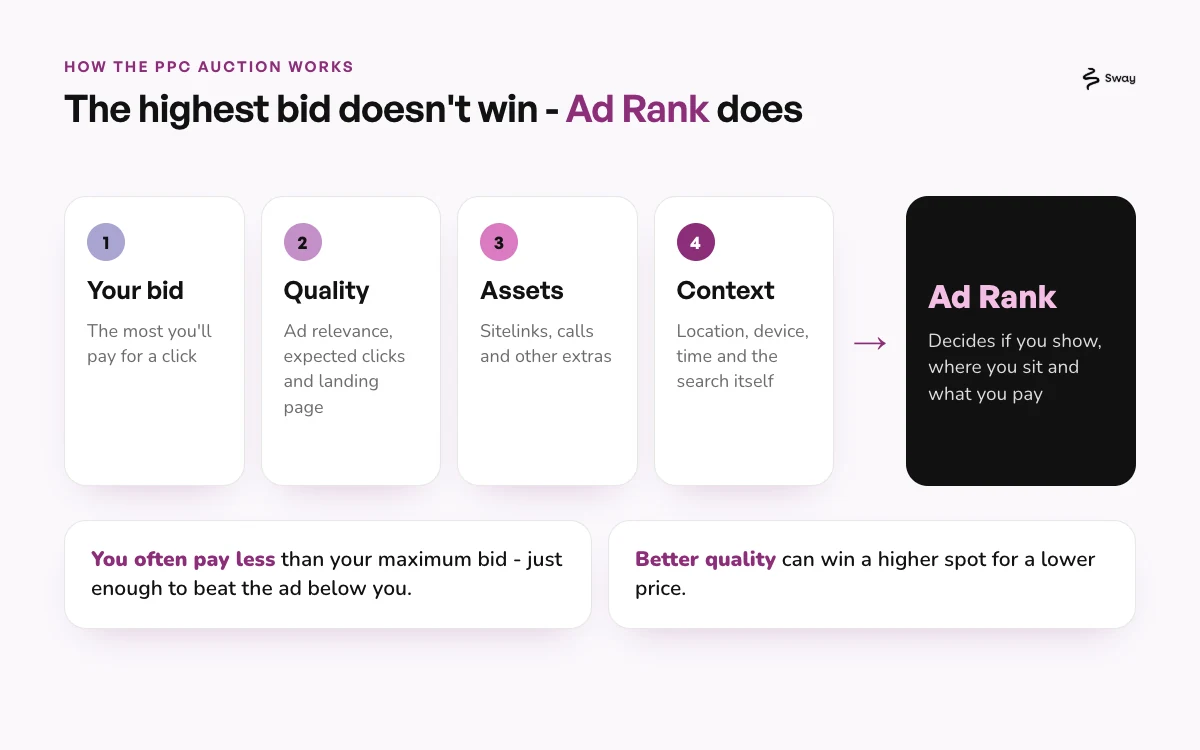
Every time someone searches, Google runs an auction for each ad space. Your bid, the quality of your ad and landing page, the assets you add and the context of the search combine to decide whether you appear and where. You usually pay less than your maximum bid.
Google lists six factors in the auction: your bid, ad and landing page quality (summarised as Quality Score), the expected impact of assets like sitelinks and phone numbers, minimum Ad Rank thresholds, the context of the search such as location, device and time, and how close the competing ads are in rank. The point most new advertisers miss is that a lower bid can still win a higher position when the keywords, ads and assets are more relevant.
Budgets work on an average. You set a daily budget, and on busy days Google can spend up to twice that figure, though across a month you shouldn't be charged more than your daily budget multiplied by 30.4. There's no minimum spend, so you decide how much goes in.
That auction logic is why landing pages matter more than most people expect. Send a high-intent click to a generic homepage and your quality signals drop, your cost per click rises and your conversion rate falls - three problems from one decision.
Tip: Before raising a bid, check the search terms report for irrelevant queries and the landing page for message match. Both usually cost less to fix than a higher bid.
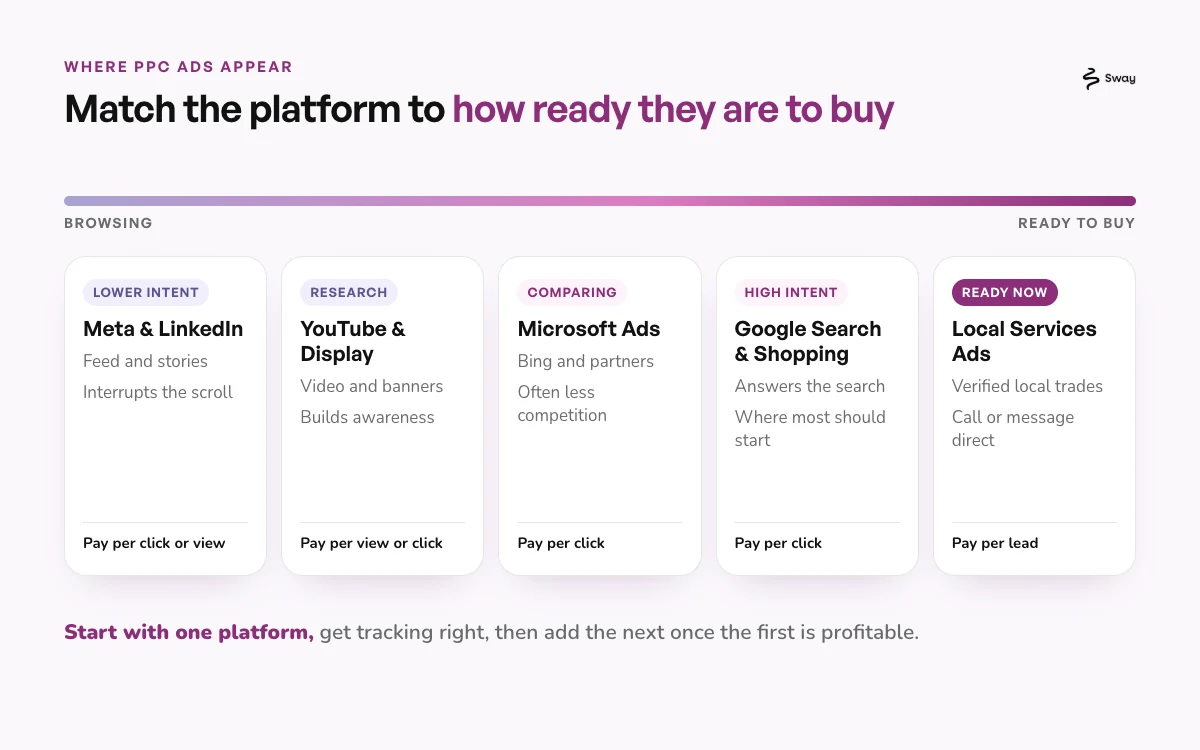
PPC isn't one platform, it's a model that runs across several, and the right mix depends on where your customers spend their time. Most businesses get the best results by starting with one platform, getting the tracking right and adding a second only once the first is profitable.
The format should match the buying moment. Someone searching for a dentist near them is ready to act, while someone scrolling Instagram hasn't decided anything yet - and your budget should follow that difference.
PPC cost is clicks multiplied by cost per click, plus any management fee. You choose your budget, so there's no fixed price. What drives the cost per click is competition: legal keywords sit at the expensive end, entertainment at the cheap end, and a well-built account pays less for the same position.
The most recent WordStream benchmark covers more than 13,000 US search campaigns across 23 industries between April 2025 and March 2026. The average click cost $5.42, with an average click-through rate of 6.64%, a conversion rate of 8.18% and a cost per lead of $66.69. Legal services sit at the top of the cost range and arts and entertainment at the bottom. These are US figures, so treat them as a sense of scale rather than a UK quote.
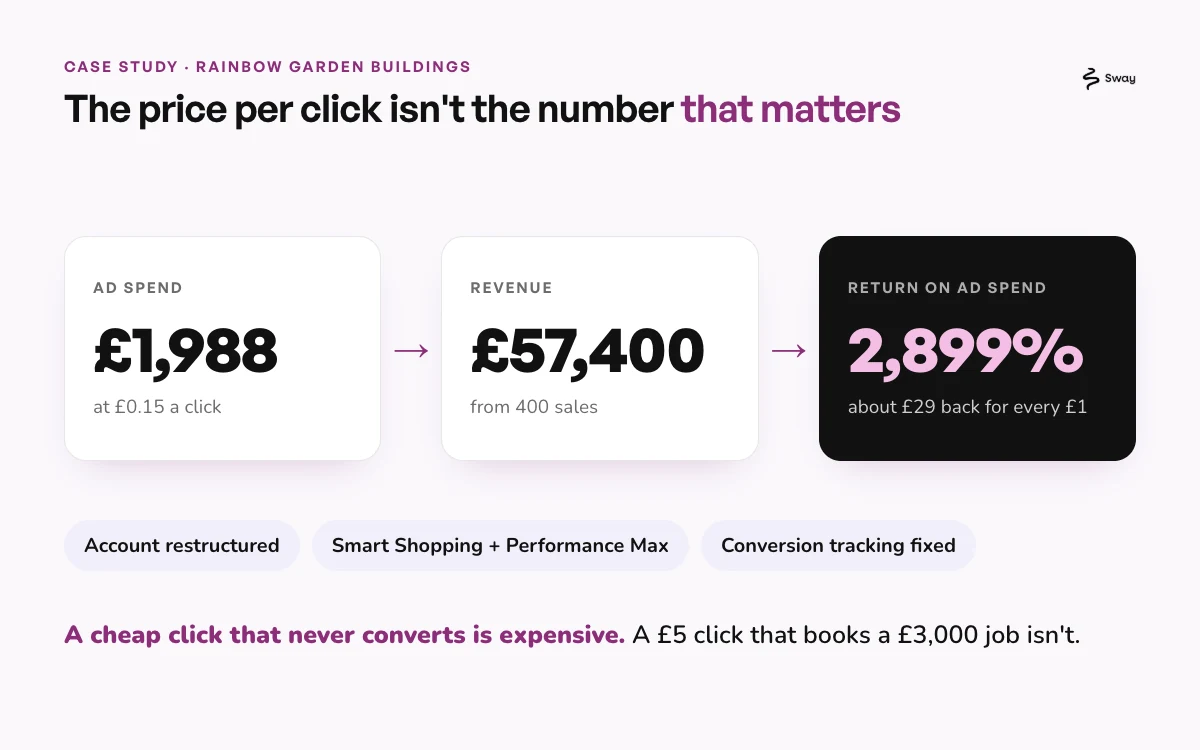
Price per click isn't the number that matters, though. When we restructured Rainbow Garden Buildings' account, added Smart Shopping and Performance Max and fixed conversion tracking, £1,988 of ad spend produced £57,400 in revenue across 400 sales, at an average of £0.15 a click. That's a 2,899% return on ad spend, and you can read the detail in the Rainbow Garden Buildings case study. A cheap click that never converts is expensive, and a £5 click that books a £3,000 job isn't.
Management fees sit on top of ad spend, whether you hire an agency or a freelancer. Our SEO and PPC packages show what's included up front, and our ROAS guide and calculator shows you how to work out the number your account has to beat.
Tip: Start with a budget you can afford to lose while the account learns, then scale only the campaigns whose ROAS clears your break-even point.
PPC delivers leads within days but stops when you stop paying. SEO takes months to build but keeps working without per-click costs. Most small businesses should start with PPC if they need enquiries now, then build SEO alongside it so the two share data and the cost of acquiring customers falls over time.
Think of PPC as renting a shop window on the high street and SEO as buying the building. The window gets foot traffic from day one, the building takes longer to pay off, and the rent never ends. For a new business with little site authority, PPC is usually the fastest route to a first enquiry.
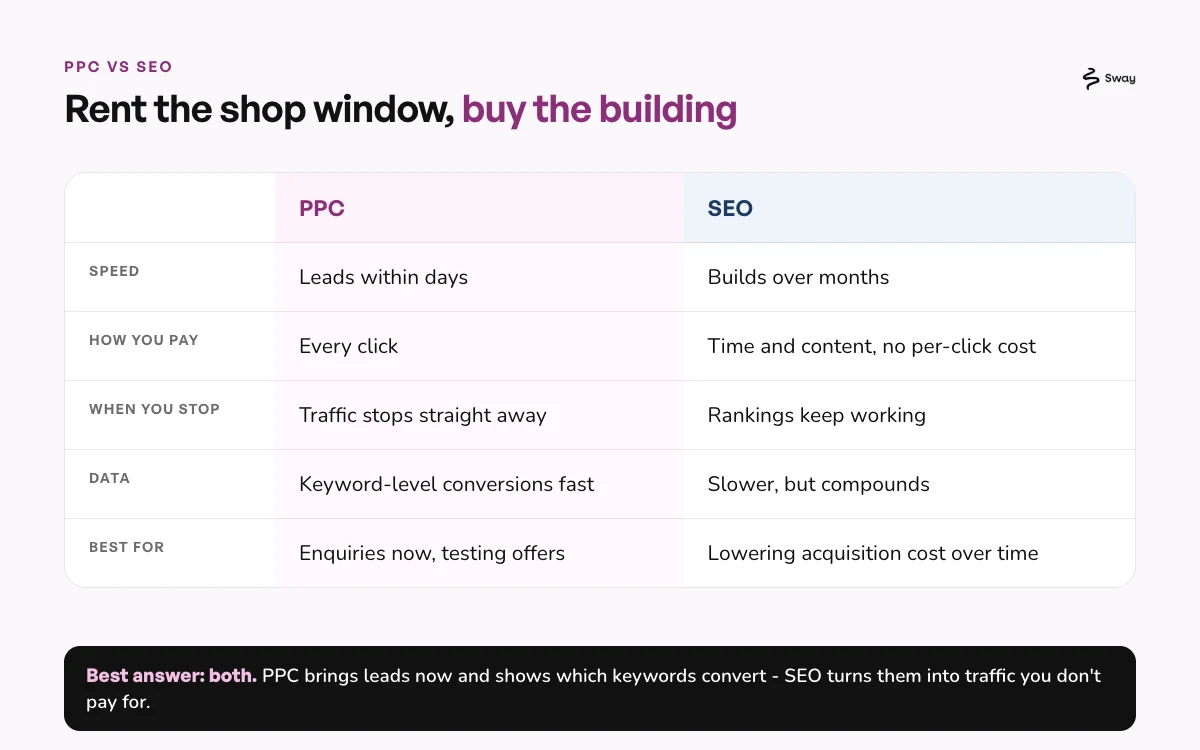
The two aren't rivals, though. Search terms that convert in PPC tell you which keywords to target organically, and strong rankings reduce how much you rely on paid clicks. We cover the combined approach in Can You Do SEO and PPC Together? and set out the specific overlaps in 5 Ways SEO and PPC Complement Each Other. If you're weighing where a first budget should go, our organic marketing guide covers the other side of the decision.
Search is changing, and PPC is moving with it. Google Ads Help confirms that text and Shopping ads from existing Search, Shopping and Performance Max campaigns can appear within AI Overviews and AI Mode automatically. You can't target the placement on its own or opt out of it separately from Search, so the way in is through campaigns you already run.
Where this stands for UK advertisers matters. Google's help page lists the markets where ads can appear inside AI Overviews and AI Mode - the US, Australia, Canada, India and several others - and the UK isn't among them yet. In late October 2026 Google expanded AI Mode ads to ten more countries, and Search Engine Land reports that the UK is planned for later in Q4 2026. Treat it as coming, not here.
One detail is worth knowing now: performance from these placements is folded into your standard campaign reports rather than broken out on its own, so you can't yet isolate how ads inside AI answers perform.
Ads are also arriving outside Google. Our ChatGPT Ads guide explains how advertising on ChatGPT works and what the UK launch means for advertisers.
PPC works best when four things are true: you sell something people already search for, you know what a customer is worth, your website can convert a visitor and you can track the result. Miss one and the money goes slowly.
A sensible first sequence looks like this:
If you already run ads and aren't sure they're working, our free PPC audit is the place to start. If you'd rather hand the whole thing over, paid advertising with Sway Digital covers Google Ads and Microsoft Ads from setup to reporting.
Three things are worth taking from this: you pay for clicks but win the auction on quality, so the ad and the landing page matter as much as the bid. Measure against your break-even ROAS rather than click counts. And treat PPC and SEO as partners, with PPC bringing leads now while organic builds in the background.
If you want a straight read on whether PPC is worth it for your business, book a free 30-minute strategy call and we'll go through your numbers together. With ads starting to appear inside AI answers, it's also worth knowing how visible you are to those tools organically - get the free AEO report to find out.
What does PPC stand for?
PPC stands for pay-per-click, an advertising model where you pay each time someone clicks your ad. When the ads appear on search engines like Google or Bing, it's also called paid search.
Is PPC the same as Google Ads?
No. PPC is the pricing model, and Google Ads is the largest platform that uses it. Microsoft Ads, Meta and LinkedIn also run pay-per-click auctions of their own.
Do you pay when someone sees your ad?
On a standard Google Ads search campaign, no. You pay when someone clicks, up to the maximum bid you set, and Google's documentation notes you often pay less. Some display and video formats can be bought on impressions instead, so check the bidding strategy.
How much should a small business spend on PPC?
There's no minimum spend, so the answer depends on your cost per click and what a customer is worth. Aim for enough budget to generate steady conversions, because Google's automated bidding needs that data to learn from - our ROAS guide covers the minimum volume. Work out your break-even ROAS first, then size the budget around it.
Is PPC better than SEO?
Neither is better outright. PPC gets leads in days and stops when you stop paying, while SEO takes months but compounds over time. Most businesses get the best result from running both, using PPC data to guide which keywords to target organically.

Written By
Founder, Sway Digital • MSc Digital Marketing Communications
Philip Beaumont is the founder of Sway Digital, a digital agency built to sway your audience - combining website design & development, SEO, paid advertising, and brand identity into strategies that move the numbers that matter. He holds an MSc in Digital Marketing Communications and works hands-on with every client, from strategy through to execution.
Connect on LinkedInReady to put this into practice?
Book a free strategy call and we'll show you exactly how this applies to your business.