
Paid Advertising
ChatGPT ads are live in the UK. What they look like, how context-hint targeting works, what they cost, how to set up Ads Manager, and a 30-day test plan.
Category
Paid Advertising
Published
23 October 2026
Read Time
14 min read
Summary
ChatGPT ads are sponsored cards shown under ChatGPT's answers to logged-in adults on the Free and Go plans. UK businesses can buy them through OpenAI's self-serve Ads Manager, which is still in beta. They're matched on conversation context rather than keywords, bought on a cost-per-click or cost-per-impression basis, and there's no published rate card. Our recommendation: run a small, tracked test alongside Google Ads rather than moving budget across.
ChatGPT ads went from nothing to a $1bn annualised run rate in under seven months. The first ads appeared in ChatGPT in the US on 9 February 2026, and according to CNBC, OpenAI's ad business had passed that $1bn run rate by 31 August. Since 11 August, UK businesses have been able to buy them too - which turns ChatGPT advertising from an American headline into a genuine budget question for UK marketers.
Most of the businesses asking us about it already run Google Ads, and the questions are nearly always the same. Can we actually buy them here? How do they target anyone without keywords? What do they cost, and should money come out of Google to pay for them?
Rather than guess, we opened Sway's own Ads Manager account to see exactly what a UK advertiser gets. This guide covers what we found inside, how ChatGPT ads work, what the early results do and don't tell you, and a 30-day plan for testing them properly.
ChatGPT ads are sponsored units that appear below ChatGPT's answer, clearly labelled as an ad and kept separate from the answer itself. Two formats are live: a sponsored card with a headline, description and image, and a shopping product carousel built from a product feed.
The ad never sits inside the answer. As TechCrunch reported at launch, OpenAI keeps the two visibly apart, so the person reads ChatGPT's response first and sees the sponsored unit underneath it. That separation is the whole basis of the format - the answer stays the answer, and the ad is a labelled suggestion next to it.
Here's what each live format looks like:
OpenAI is also testing two newer formats, in the US only for now. According to OpenAI's announcements and Neil Patel's coverage, visual ads are appearing inside image generation, and Sponsored Agents let someone who clicks an ad carry on in a labelled chat with the business's own AI agent. Neither is open to UK advertisers yet, but they show the direction of travel - away from an ad you click away from, towards a conversation you have with the brand inside ChatGPT.
Yes. ChatGPT ads have been live in the UK since 11 August 2026, and UK businesses can sign up through OpenAI's self-serve Ads Manager, which is still labelled Beta. Ads are only shown to logged-in adults on the Free and Go plans, never to under-18s, and never next to sensitive topics.
The UK launch was confirmed by OpenAI and covered by Search Engine Land, and it came on the back of a bigger change in the US. According to Search Engine Journal and Adweek, OpenAI launched its self-serve Ads Manager in early May 2026, added cost-per-click bidding alongside cost-per-impression, and dropped the $50,000 minimum that applied during the pilot. That's what opened the door to small and medium businesses - before May, this was a channel for big brands only.
Who actually sees your ad matters just as much as where it runs:
If you sell B2B, that second point is worth sitting with - anyone using ChatGPT through a Business or Enterprise workplace plan won't see your ad at all.
There's one restriction UK healthcare and finance businesses need to know about. OpenAI's ad policies, as set out in independent reviews of the platform, currently limit health and finance advertisers to the US. If you run a pharmacy, a private clinic, a dental practice or a financial advice firm, ChatGPT ads aren't an option for you yet. The same policies say personalised ads aren't available in the EEA or Switzerland, but the UK sits outside the EEA, so that particular limit doesn't apply here.
The UK isn't an outlier either. OpenAI and Search Engine Land report that ChatGPT ads now run in more than a dozen markets, including Canada, Australia, New Zealand, Japan, Korea, Brazil, Mexico, Europe and the Middle East.
This is the part that catches out anyone coming from Google Ads. The targeting logic is different at its root, so the way you plan, build and optimise a campaign has to change with it.
Google Ads matches the words someone types. ChatGPT matches the conversation they're having. Instead of a keyword list with match types, you write free-text "context hints" describing the kinds of conversations your product or service fits, and OpenAI uses those to decide when your ad is relevant.
According to OpenAI's Help Centre, context hints guide the matching but aren't exact-match rules. ChatGPT also takes into account the wider conversation, past chats if the user has memory switched on, and how they've interacted with ads before. Think of it like the difference between telling a waiter exactly which dish to bring and briefing the maître d' on the kind of guest who'd enjoy your table - you're describing a situation, not naming an order.
For Sway, a context hint might read something like "UK small business owner frustrated with rising Google Ads costs, asking how to cut wasted spend or whether to hire a PPC agency". That's a description of a moment in someone's decision, not a search term. It's also why the Google Ads mindset doesn't carry over cleanly - there are no exact or phrase match types to tighten, no keyword-level bids, and no list of queries to pick through afterwards.
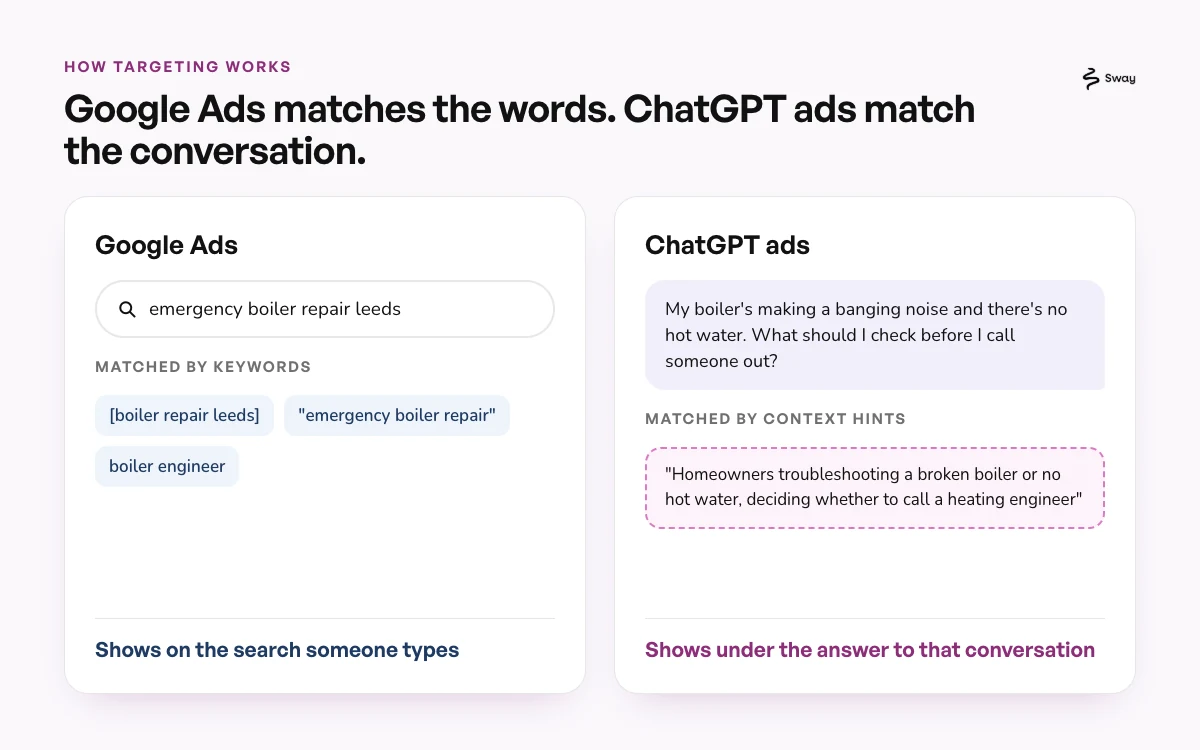
Independent reviews of Ads Manager and OpenAI's own Help Centre set out the controls available today.
What you can control:
What you can't control:
That second gap is the big one for anyone used to Google Ads. In Google, the search terms report is where most of the optimisation happens - you see what people typed, add negatives and tighten match types. In ChatGPT, you're working from aggregated results and adjusting your context hints and creative based on what converts.
You get aggregated performance data only, with no access to anyone's conversations. OpenAI's position, reported by TechCrunch, is that ads don't influence the answers ChatGPT gives - so paying for an ad doesn't buy you a mention in the answer itself.
For most businesses that's reassuring rather than limiting. It means the answer stays trustworthy, which is exactly what makes the ad underneath worth being next to.
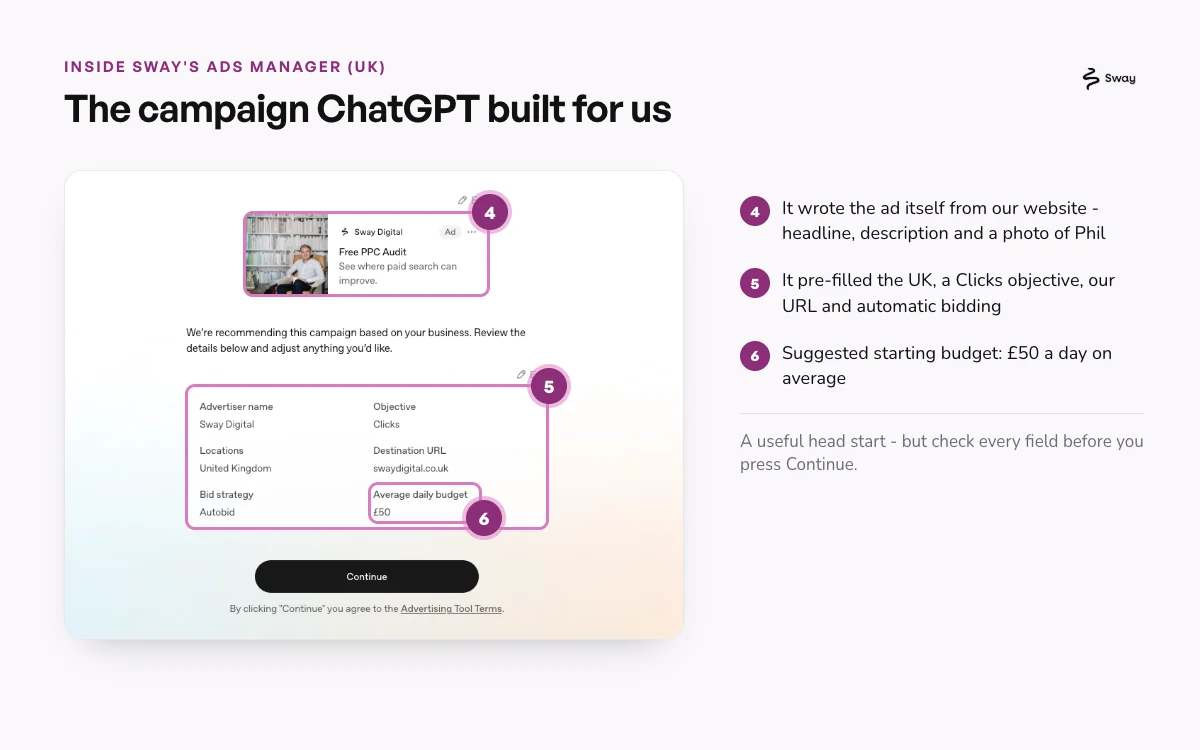
There's no published rate card or monthly fee for ChatGPT ads. You set a budget and bid on a cost-per-click (CPC) or cost-per-thousand-impressions (CPM) basis. OpenAI's suggested starting CPC is $3-5, the US minimum daily budget is $25, and when we opened Sway's UK account, the suggested campaign defaulted to a £50 average daily budget.
According to an independent review of Ads Manager, the bidding options are:
The $25 minimum daily budget is in US dollars and varies by currency, and the same review notes that a campaign can spend up to twice its daily budget on a given day, much like Google Ads. Budget for that when you set your cap.
Be wary of anyone quoting firm UK numbers. There are no reliable benchmarks for ChatGPT ads yet, let alone UK ones, and the CPM figures circulating from third parties are estimates rather than published rates. Anyone who tells you what a ChatGPT click costs in the UK is guessing.
Tip: start with what a click costs you on Google Ads today and what your cost per lead looks like there. Then work out the most you can afford to pay for a ChatGPT click - your target cost per lead multiplied by the conversion rate you'd expect from the landing page. If OpenAI's suggested bid sits well above that figure, you know before you spend a penny that the test needs a better-converting page or a higher-value offer.
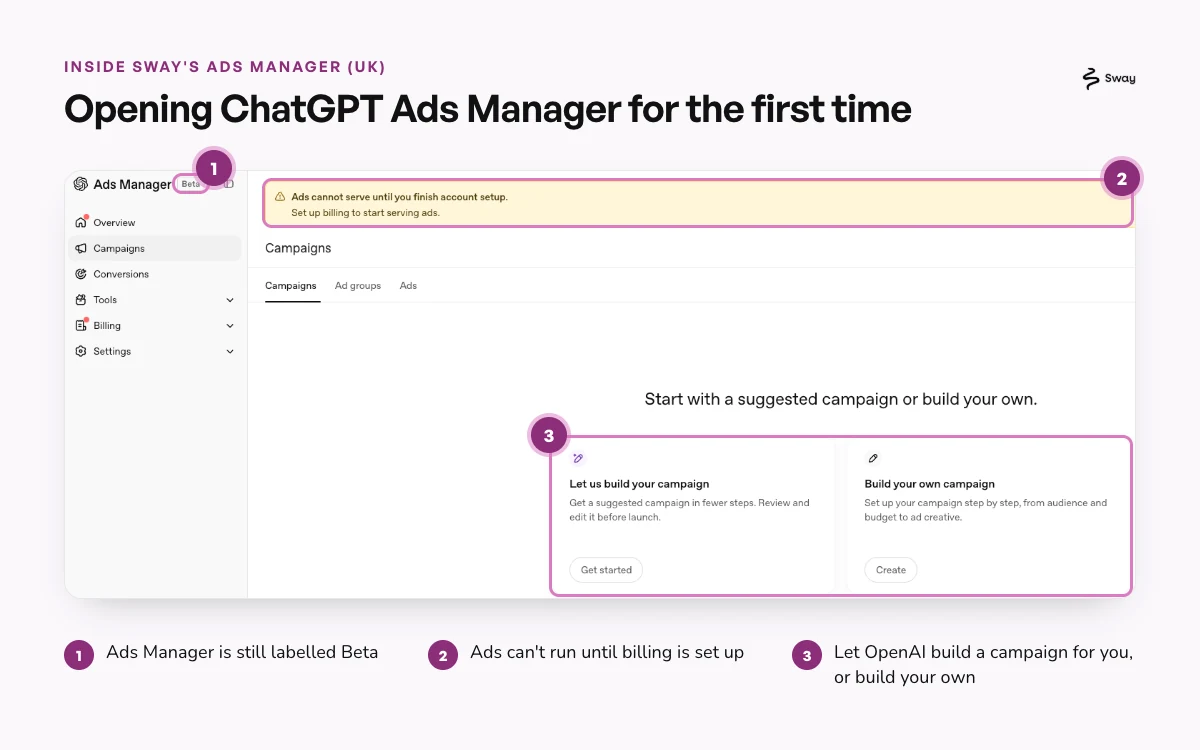
To advertise on ChatGPT, create a Business account in OpenAI's Ads Manager, choose a suggested or custom campaign, set your objective, budget and context hints, write the ad, install conversion tracking, then add billing and submit for review. Ads can't run until billing is set up.
Here's the process step by step, including what we saw in Sway's own account in October 2026.
Create your Ads Manager account. Sign up at OpenAI's ads site and choose Business rather than Individual. Set the country, currency (GBP) and time zone carefully - these are the settings everything else reports against, so get them right first time.
Choose how to build the campaign. Ads Manager offers two routes: "Let us build your campaign", a suggested campaign built in fewer steps, or "Build your own campaign", which takes you through it step by step. When we tried the suggested route, Ads Manager built a full campaign from our website on its own. It wrote an ad headlined "Free PPC Audit" with the description "See where paid search can improve", pulled a photo of Phil from the site, and pre-filled the advertiser name, United Kingdom, a Clicks objective, swaydigital.co.uk as the destination, automatic bidding and a £50 average daily budget. It's a genuinely useful starting point - but check every field, because none of it was set with your margins in mind.
Pick the campaign type and objective. Choose Standard or Product Feed (for shopping carousels), then an objective: Reach, Clicks or Conversions.
Set your budget and bidding. Choose CPC or CPM, and automatic or manual bidding. Set a daily budget you're comfortable seeing spent twice over on a busy day.
Write your context hints, locations and platforms. Describe the conversations your offer fits, set locations down to region or postcode if you're local, and choose the platforms you want to appear on.
Write the ad. Headlines can be up to 50 characters, though OpenAI recommends 16-24. Descriptions can run to 100 characters, with 32-48 recommended. You'll also need a square image. Short wins here - the recommended lengths are roughly half the maximums for a reason.
Set up conversion tracking. Install the OpenAI pixel, the Conversions API, or both. OpenAI also offers a Codex plugin that sets tracking up for you, a Shopify app, and a HubSpot connection in beta. According to the independent review, attribution windows are 7, 14 or 30 days for clicks and 0 or 1 day for views.
Add billing and submit for review. Our account showed a clear banner saying ads couldn't serve until billing was set up. Once it's added, the campaign goes to review before it can run.
The honest read is that the early numbers are encouraging but almost all of them come from one side of the table.
The positive results so far have come from OpenAI and its measurement partners. WeightWatchers saw a cost per acquisition 15.3% below its blended paid search average. Portland Leather reported that 93% of its ChatGPT ad visitors were new to the site. An unnamed advertiser reached 3x return on ad spend over 28 days. They're real results - but they're selected results, shared by the platform selling the ads.
The one independent test reported so far tells a different story. According to MediaPost on 31 August 2026, a Canadian agency running ChatGPT ads saw a click-through rate of about 0.6% and no purchases. One test isn't a verdict either, but it's a useful counterweight to the case studies.
Put together, ChatGPT ads look promising and unproven, and there's almost nothing published from the UK yet. That isn't a reason to ignore the channel - it's the reason to test it properly, with tracking you trust, rather than taking anyone's numbers at face value, including ours once we have them.
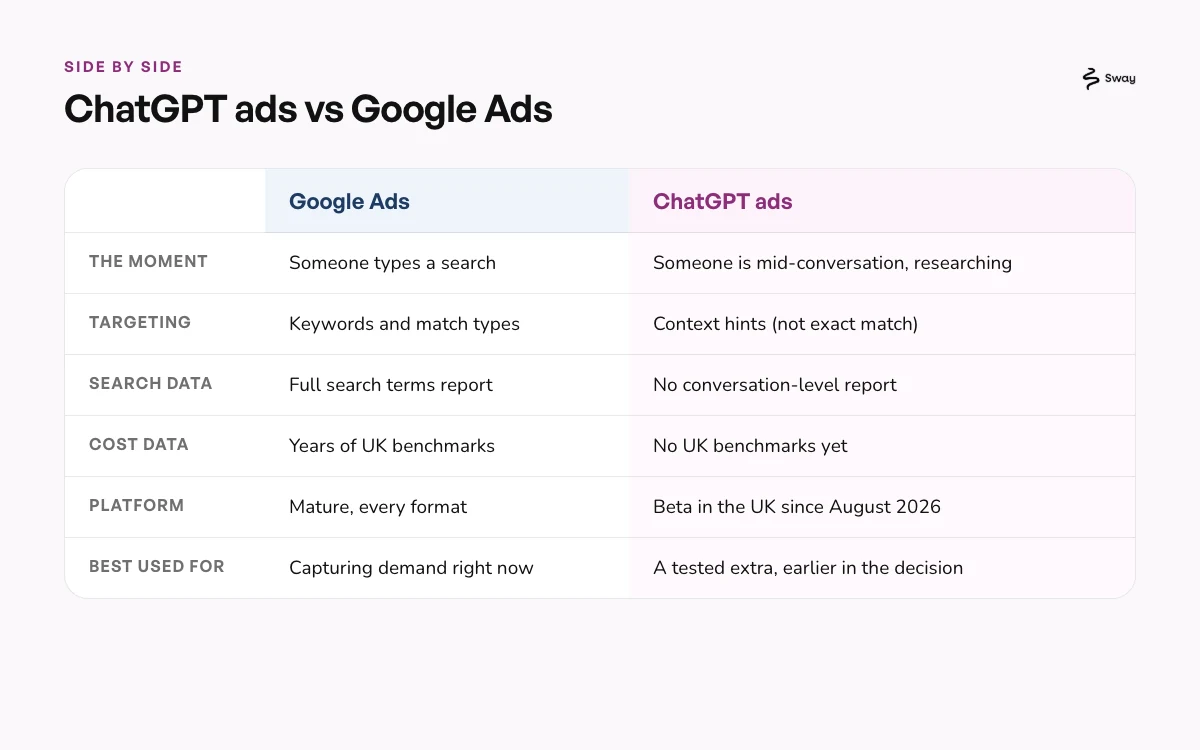
Google Ads captures demand from people actively searching, with mature targeting, full query data and years of cost benchmarks. ChatGPT ads reach people earlier, while they're still researching in a conversation, but with looser targeting, no search terms report and no reliable benchmarks. For now, Google Ads stays the core and ChatGPT ads are a test.
Here's how the two compare side by side:
| ChatGPT ads | Google Ads | |
|---|---|---|
| Intent | Someone mid-research, working through a decision in a conversation | Someone typing a search, often close to acting |
| Targeting | Context hints, conversation context, customer lists, location | Keywords and match types, audiences, location |
| Reporting | Aggregated performance, no search terms report | Full search terms and query-level data |
| Cost data | No published rate card, no UK benchmarks | Years of CPC and conversion data |
| Maturity | Beta | Mature platform |
| Formats | Sponsored card, product carousel | Search, Shopping, Performance Max, Display, YouTube and more |
The biggest difference is where in the decision you meet someone. A Google search like "PPC agency Manchester" is someone ready to shortlist. A ChatGPT conversation about why Google Ads costs keep rising is someone earlier in the journey, still working out what the problem is. Both are valuable, but they're not the same click, and they shouldn't be judged on the same day-one numbers.
That's why we don't see ChatGPT ads as a replacement. Google Ads stays the core for capturing existing demand, and ChatGPT ads are a new place to be considered earlier, before the search happens.
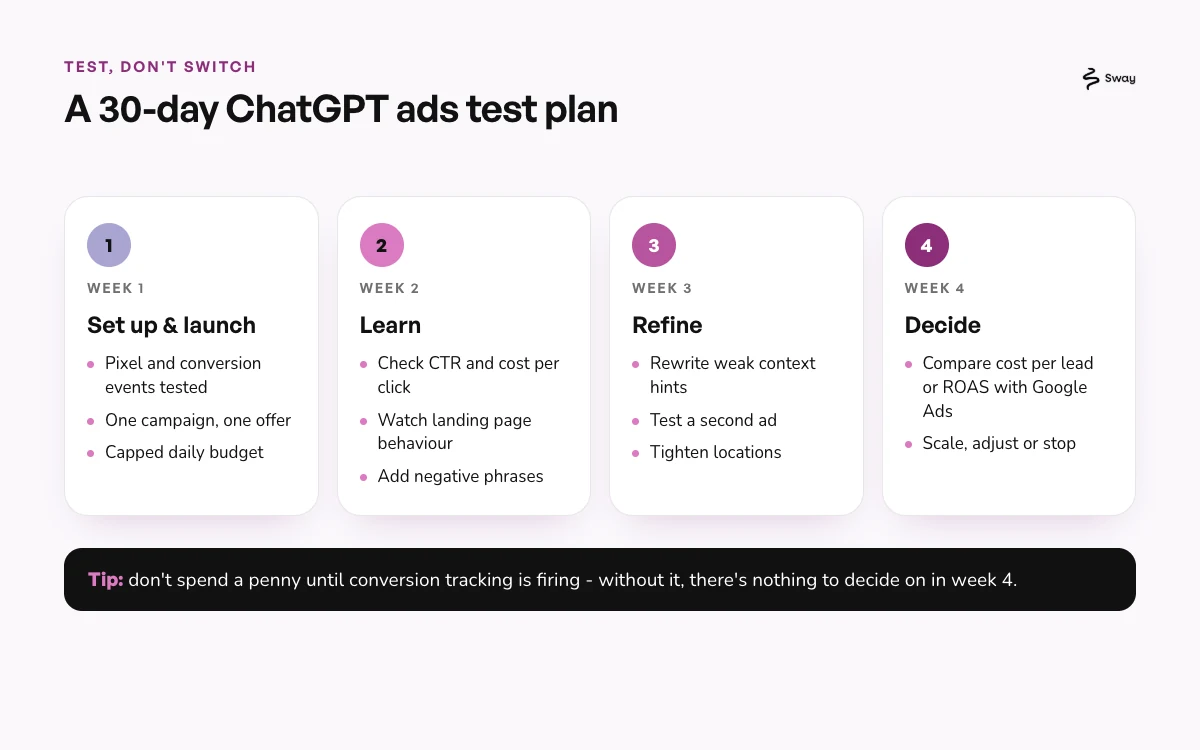
Yes, if you have a considered purchase, working conversion tracking and budget headroom. Fund the test from a small slice of budget, run it alongside Google Ads rather than instead of it, and judge it on cost per lead or ROAS after 30 days. Regulated health and finance businesses will need to wait.
Worth testing now if you have:
Worth waiting if you're:
Tip: get conversion tracking right before you spend a penny. Without it, a ChatGPT ads test produces clicks and opinions, not a decision.
There are two ways to show up in ChatGPT, and they work very differently. Paying puts you under the answer. Being cited puts you inside it - and that part can't be bought.
ChatGPT builds its answers from sources it trusts, which is why answer engine optimisation (AEO) still matters alongside ads. If your site is the clearest, most credible source on a topic, ChatGPT is more likely to cite it, and that citation sits in the answer people actually read. Our free AEO report shows where your brand currently stands in AI answers, which is a sensible thing to know before deciding how much to spend on the ad slot underneath them.
The bigger picture is that AI search is becoming an ad channel across the board. Microsoft has ads in Copilot, and Google now shows ads in AI Overviews and AI Mode - which we cover in our guide to AI Overviews in Google Search. Not everyone is going the same way, though - according to MacRumors and the Financial Times, Perplexity has stepped back from ads. The businesses that do well here will treat paid and organic AI visibility as one plan, not two separate projects.
ChatGPT ads are live in the UK, self-serve and open to businesses of any size, with no published rate card and a suggested starting budget of around £50 a day. They're matched on conversation context rather than keywords, which makes them a genuinely different channel from Google Ads rather than a cheaper copy of it. And the early results are promising but mostly come from OpenAI itself, with almost nothing published from the UK yet.
So test, don't switch. Keep Google Ads as the core, fund a capped 30-day test, and judge it on cost per lead or ROAS against what you already know works.
If you want help planning that test, book a free 30-minute strategy call and we'll map out whether ChatGPT ads fit your business - or see our PPC packages if you'd rather we ran it for you. And before you test any new channel, make sure your tracking and Google Ads account are in shape - our free PPC audit will show you exactly where they stand.
Are ChatGPT ads live in the UK?
Yes. ChatGPT ads launched in the UK on 11 August 2026, and UK businesses can sign up through OpenAI's self-serve Ads Manager, which is still in beta. Ads are shown to logged-in adults on ChatGPT's Free and Go plans only.
How much does it cost to advertise on ChatGPT?
There's no published rate card or monthly fee. You bid on a cost-per-click or cost-per-impression basis, with a suggested starting CPC of $3-5 and a US minimum daily budget of $25 that varies by currency. When we opened Sway's UK account, the suggested campaign defaulted to a £50 average daily budget, and there are no reliable UK CPC benchmarks yet.
Do ads change ChatGPT's answers?
No. OpenAI says ads don't influence the answers ChatGPT gives, and they're labelled and shown separately underneath the answer. Advertisers only get aggregated performance data and can't see anyone's conversations.
What do ChatGPT ads look like?
The main format is a sponsored card under ChatGPT's answer, labelled as an ad, with a headline, a short description, a square image and an "Ask ChatGPT about this ad" option. Ecommerce businesses can also run a shopping product carousel built from a product feed.
Is advertising on ChatGPT worth it for a small business?
It's worth testing if you sell a considered purchase, already have working conversion tracking and can spare a small slice of budget. The early results are promising but mostly come from OpenAI and its partners, so run a capped 30-day test alongside Google Ads rather than moving budget across. Regulated health and finance businesses can't advertise in the UK yet.

Written By
Founder, Sway Digital • MSc Digital Marketing Communications
Philip Beaumont is the founder of Sway Digital, a digital agency built to sway your audience - combining website design & development, SEO, paid advertising, and brand identity into strategies that move the numbers that matter. He holds an MSc in Digital Marketing Communications and works hands-on with every client, from strategy through to execution.
Connect on LinkedInReady to put this into practice?
Book a free strategy call and we'll show you exactly how this applies to your business.