Website Design & Development Organic Marketing Paid Advertising Branding & Identity Digital Strategy Email Marketing Website Design & Development Organic Marketing Paid Advertising Branding & Identity Digital Strategy Email Marketing

Insights — Organic Marketing

Harnessing data for more effective SEO with Google Search Console.

How Google Search Console turns SEO from guesswork into a measurable, data-driven strategy — from keyword targeting to content planning to proving ROI.

Read Time

9 min read

Core Tool

Google Search Console

Key Report

Performance

Approach

Data-driven, not guesswork

With the wealth of data available today, tools like Google Search Console let us understand customer behaviour, preferences, and trends more deeply than ever before. That empowers us to personalise campaigns, optimise performance, and ultimately drive better outcomes. Data isn't just a resource — it's the foundation of smarter search engine optimisation.

What Is Data-Driven SEO?

Measurable insight, not guesswork.

Data-driven SEO is a strategic approach that leans on data and analytics to inform decisions, optimise performance, and improve search visibility. Much like data-driven marketing — which uses customer data and behavioural insight to craft personalised campaigns — data-driven SEO relies on measurable insight rather than assumptions or generic best practice.

By analysing keyword performance, user behaviour, traffic sources, and real-time engagement, businesses can spot patterns in how users interact with a site and how search engines respond — allowing SEO teams to create content that's genuinely aligned with both audience needs and search algorithms.

Where traditional SEO often depends on assumptions, a data-driven approach uses tools like Google Analytics, Google Search Console, and keyword research platforms such as Ahrefs or SEMrush to gather insight that shapes decisions across content creation, technical SEO, backlinks, and on-page optimisation — enabling more accurate targeting, sustainable organic growth, and results that are easier to prove.

Google Search Console

Direct insight, straight from Google.

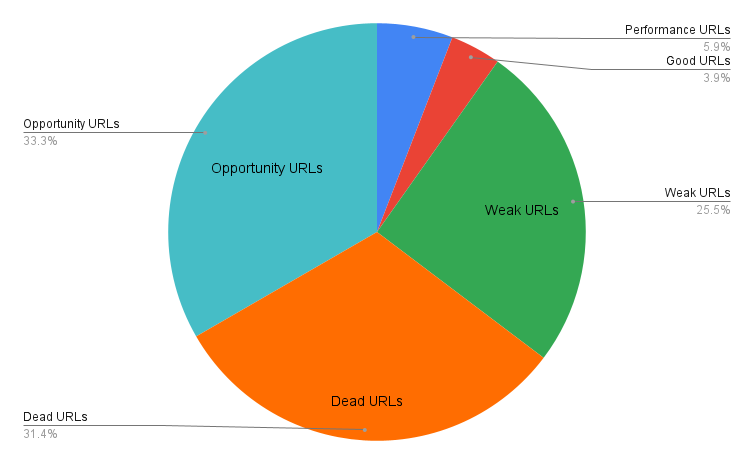
When we work with clients, Google Search Console is central to how we understand their site's performance in Google Search — guiding keyword strategy, content creation, and SEO optimisation. The chart below, for example, breaks down a real client's URLs by performance category — sourced directly from GSC, and reliable enough to build a strategy on.

Pie chart breaking down a client's URLs by performance: Opportunity URLs 33.3%, Dead URLs 31.4%, Weak URLs 25.5%, Performance URLs 5.9%, Good URLs 3.9%

The Benefits

What data-driven SEO actually gets you.

Data-driven SEO uses actionable insight from real user data to help brands understand search behaviour, optimise content and keyword targeting, and improve visibility — ultimately driving more qualified traffic and stronger digital performance. Five benefits stand out in particular.

01

More Effective Keyword Targeting

Rather than relying on assumptions or static keyword lists, a data-led approach uses real-time insight — search volume, click-through rate, and user intent — to identify the keywords that actually matter for your business. GSC's Performance report shows the exact queries people use to find your site, revealing not just what's already driving clicks, but where you're visible without yet performing well.

02

Smarter, Insight-Led Content Strategies

GSC lets you see exactly how users find your content in search, which queries drive traffic, and how individual pages perform — replacing guesswork about what might perform well with real demand data.

Done consistently, this improves content relevance, reduces bounce rates, strengthens topical authority and E-E-A-T, and lets your content strategy evolve alongside your audience rather than against a static plan.

03

Better Understanding of User Behaviour

GSC's Performance report goes beyond traditional analytics to show why users engage with your site the way they do — through search queries, click-through rate on individual pages, average position, and device or geographic breakdowns.

Tip: monitor click gaps by page over a six-month period. A drop in clicks often signals a decline in keyword rankings — a useful early warning for which pages need attention.

04

Improved Search Visibility

Visibility — how prominently and how often your site appears for relevant queries — is one of the most tangible outcomes of a data-driven approach. GSC's Performance report shows impressions, click-through rate, average position, and your top-performing queries and pages, giving you a clear read on where you stand.

05

Measurable ROI and Long-Term Performance Gains

Unlike marketing efforts that can lack direct attribution, SEO backed by GSC provides transparent, quantifiable results over time — tying effort directly to traffic growth, keyword rankings, and engagement.

Tip: analysing the position gap of pages — whether they're rising or falling in search position — is another useful way to spot exactly which pages need attention to lift overall rankings.

Putting It Into Practice

Key strategies for data-driven marketing.

Collecting the Right Data

A data-driven approach starts with capturing high-quality, relevant data. CRM systems and social analytics provide behavioural and demographic insight — GSC adds to that picture with direct visibility into how users find and engage with your site through organic search:

Search queries leading users to your site Impression & click data on content Top-performing pages by visibility Device & location data

Analysing Data Effectively

Turning raw data into action is the core of data-driven marketing. GSC complements traditional analytics by helping you identify which keywords and pages drive organic traffic, spot high-impression, low-CTR opportunities, monitor ranking trends, and understand how visibility shifts across mobile and desktop — feeding directly into bigger KPIs like customer lifetime value and conversion rate.

Creating Data-Driven Campaigns

Campaigns become far more effective when they're rooted in search data. GSC reveals what users are actively searching for, helps segment audiences by behaviour, geography, or device, and allows real-time performance tracking of search-driven landing pages — reducing spend on ineffective strategies and improving ROI.

Conclusion

Search data as a strategic asset.

Data-driven marketing is most powerful when insight from Google Search Console is fully built into campaign planning and performance tracking. GSC doesn't just reveal how your audience discovers your brand — it gives you the visibility needed to optimise content, target keywords more effectively, and refine messaging in real time. Challenges like data privacy, system integration, and analysing data at scale are real, but manageable with the right tools and framework. Treat search data as a strategic asset, and the payoff is stronger performance, more personalised engagement, and growth that actually compounds.

Philip Beaumont, founder of Sway Digital

Written By

Philip Beaumont

Founder, Sway Digital • MSc Digital Marketing Communications

Philip Beaumont is the founder of Sway Digital, a digital agency built to sway your audience — combining website design & development, SEO, paid advertising, and brand identity into strategies that move the numbers that matter. He holds an MSc in Digital Marketing Communications and works hands-on with every client, from strategy through to execution.

Connect on LinkedIn

Want a Data-Driven SEO Strategy?

Let's put your data to work.

Book a free 30-minute strategy call. We'll talk through your goals and follow up with a clear plan.