Insights - AI Agents
Your dispensary team is under more pressure than ever. Here's how AI is quietly handling thousands of routine inbound calls - so your staff can focus on the patients standing in front of them.
Read Time
11 min read
Prescriptions Dispensed
1.16bn items, England 2024/25
Workload Pressure
88% cite it as top pressure
Starting Cost
From £500 / month
The Problem
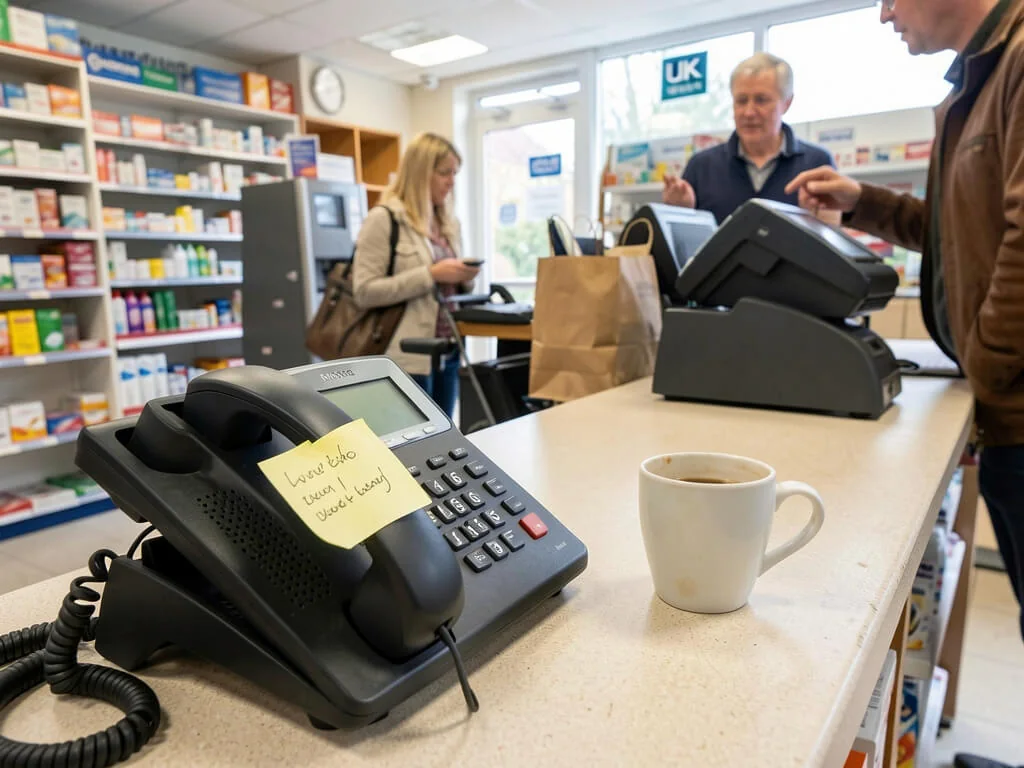
It's 9.15am on a Tuesday. Your pharmacist is counselling a patient about a new medication. Your dispensing technician is working through a stack of morning prescriptions. The counter assistant is halfway through a Pharmacy First consultation.
The phone rings. Nobody answers. The caller - a regular patient wanting to know whether their repeat prescription is ready - waits, then hangs up. They'll try again later, or turn up in person during your lunchtime rush to ask the same question. Either way, it cost your team time they don't have.
This happens dozens of times a day in UK community pharmacies. And unlike a missed booking in a private practice, each missed pharmacy call doesn't just represent lost revenue - it represents a patient who can't get the information they need about their medication.
Data from Community Pharmacy England shows the scale: 1.16 billion prescription items were dispensed by community pharmacies in England in 2024/25 - a 30% increase per pharmacy over six years, per the Pharmaceutical Journal, while the number of pharmacies has fallen to its lowest point since 2015. Each pharmacy is managing significantly more work with the same or fewer staff, and every routine phone query pulls someone away from the dispensary bench. AI in pharmacy is how forward-thinking teams are starting to reclaim that time - using the same AI agents already handling front-desk calls for dental practices elsewhere in healthcare - not by replacing clinical judgement, but by removing the routine administrative burden of answering the same questions, repeatedly, all day long.
What It Handles
The vast majority of inbound pharmacy calls fall into a small number of predictable categories - ones AI handles accurately, consistently, and without any staff involvement, much like the call types covered in our complete guide to AI answering services.
"Is my prescription ready?" is the single most common inbound call in most pharmacies. AI answers immediately, checks your system, and gives a clear answer - 24 hours a day.
What time do you open, are you open on bank holidays, which branch has evening hours - answered instantly, including when the query itself arrives after closing.
With medicine shortages now a daily reality, patients call ahead before travelling. AI gives a configured response based on your current stock situation.
Patients requesting a repeat can be directed to your online ordering system, have their details confirmed, or have the request logged for your dispensary team.
"Do you do blood pressure checks?" "Are you doing flu jabs?" AI handles routine queries about Pharmacy First, vaccinations, and other commissioned services.
Patients on home delivery schemes call to confirm timing or rearrange collections. AI handles the routine coordination, escalating genuine changes to a pharmacist.
What it does not handle
Clinical queries, medication counselling, adverse reaction concerns, and anything requiring a pharmacist's judgement are escalated to a human immediately. A well-configured system always has a clear, tested escalation path to a qualified member of staff.

Sector Pressure
Community Pharmacy England's 2025 Pharmacy Pressures Survey lays out the conditions UK pharmacies are operating under - and why many owners are actively looking to reduce administrative workload on their teams.
88%
Cite workload as a top pressure in 2025
70%
Report impacts on mental health and wellbeing
95%
Say staffing shortages increase daily pressure
1 in 4
Spend 2+ hrs daily managing medicine shortages
Source: Community Pharmacy England Pressures Survey 2025
That 88% workload figure is the highest since CPE first ran the survey in 2022, when it stood at 78% - moving in the wrong direction. Each community pharmacy in England now dispenses around 104,000 prescription items a year, up 18.5% since 2014/15, while over 90% of pharmacists report no matching increase in staffing.
In this context, every routine call handled without a member of staff picking up the phone represents genuine relief. A pharmacy receiving 40 inbound calls a day - conservative for most community pharmacies - where 60% are routine, means 24 calls that don't need a pharmacist or technician. That's 30–45 minutes of staff time a day redirected to clinical work. Over a month, it's material.
Pharmacies that continue to have clinical staff fielding routine calls aren't just losing staff time - they're contributing to the burnout and morale crisis the sector is already grappling with. Protecting dispensary staff from avoidable interruption is both a business decision and a workforce wellbeing one.
How It Works
01
The patient dials your existing pharmacy number - no change to your number, no new hardware. The call routes to your AI receptionist in under two seconds, invisibly to the caller.
02
In line with UK GDPR, the AI identifies itself as an automated assistant at the start of the call, then greets the patient using your pharmacy name and tone.
03
The patient explains what they need in their own words - no specific phrases required. "I just wanted to check if my tablets are in" is understood just as accurately as "I'm calling about my repeat prescription."
04
For opening hours, services, and location, the AI draws on information set up in advance. For prescription status, this can connect to your PMR system where possible, or use a configured response based on your collection timelines.
05
The patient gets a clear, accurate answer. Messages are logged with name, number, and details; prescription requests are logged automatically for your dispensary team to action.
06
Any call involving clinical judgement or patient safety transfers straight to your designated pharmacist - configured before the system ever goes live, with no ambiguity in the escalation path.
Built By Us
Sway Digital works with UK healthcare businesses every day - pharmacies, dental practices, GP surgeries - and we hit this exact problem ourselves before ever offering a solution to a client. That's what led to Avai, our AI receptionist venture, built from the ground up around healthcare call patterns rather than adapted from a generic business chatbot.
"We built it because we had the same problem our clients do - calls going unanswered whilst we were busy doing the work. We installed our own AI phone receptionist and the difference was immediate: more consultations booked, zero missed calls, and not a single lead lost to voicemail."- Philip Beaumont, Founder, Sway Digital & Avai
That healthcare background shapes every configuration decision - understanding that a pharmacist's primary obligation is to the patient in front of them, not the phone, and that UK GDPR and healthcare data handling need to be built in from day one, not bolted on. For pharmacies specifically, the system is configured around the real call patterns of UK pharmacy patients: repeat prescription queries, opening hours calls before a bank holiday, stock questions during a shortage.
Compliance
Pharmacies handle sensitive health data every day, so any AI voice system deployed must meet a higher compliance bar than a general business. Every call involves processing personal data - at minimum the caller's number, name where given, and their query. Health information counts as special category data, requiring an additional lawful basis under Article 9 of UK GDPR - typically Article 9(2)(h), health or social care purposes.
Your AI system must disclose at the start of every call that the interaction is automated. The ICO's guidance on AI and data protection is clear that transparency about automated processing isn't optional.
Where calls are recorded, patients must be told at the start and why - and in pharmacy, recordings involving health queries are health data, requiring the same access controls and retention limits as other patient records. Pharmacies operating under NHS contracts have additional data-sharing obligations too: any AI system must be compatible with your existing data processing agreements and DPIA, and should never be used to process clinical decisions - only administrative call handling, with clinical queries always escalated to a pharmacist.
Important
This section is general regulatory information, not legal or regulatory advice. Pharmacy owners should seek independent guidance from a solicitor or data protection officer to confirm their deployment meets all applicable requirements, including NHS data governance obligations.
The Real Cost
A part-time pharmacy assistant hired mainly to handle inbound calls costs a minimum of £12,000–£16,000 a year in salary alone, before NICs, pension, and recruitment. A full-time member adds £26,000–£30,000 - and still only covers your staffed hours. Calls at 8pm on a weekday, or 11am on a Sunday, go unanswered regardless. For the full breakdown of these figures, see our full AI vs human receptionist comparison.
Most pharmacies don't have dedicated reception staff - clinical team members take calls between other tasks. At an average pharmacist salary of roughly £47,000 a year, each hour spent on routine administrative calls costs £22–£26 in clinical time. For a pharmacy handling 40 routine calls a day at two minutes each, that's over £200 a week in misapplied clinical resource.
| Option | Monthly Cost | Coverage | Concurrent Calls |
|---|---|---|---|
| Avai AI pharmacy receptionist | From £500 | 24/7, 365 days | Unlimited |
| Part-time reception assistant | £1,000–£1,400 | Staffed hours only | One at a time |
| Full-time reception staff | £2,170–£2,500 | Staffed hours only | One at a time |

Getting Started
Getting an AI receptionist live in a pharmacy is a short, guided process rather than a technical project you have to run yourself:
FAQ
Yes. An AI voice receptionist can confirm whether a repeat prescription is ready, take a request to process one, and direct patients to collect or arrange delivery - all without pharmacy staff needing to answer the phone.
Yes, when deployed correctly. Every call is disclosed as being handled by an AI assistant, call recording is disclosed where applicable, and data is handled in line with UK GDPR requirements. Compliance is built into every pharmacy deployment.
Pricing starts from £500 per month - a fraction of the cost of additional reception staff.
Yes - best practice and UK GDPR both require the AI to identify itself at the start of the call. Most patients are comfortable with this when the interaction is quick and resolves their query.
Yes. Unlike a single member of staff, an AI voice system can handle unlimited simultaneous inbound calls - critical during peak morning periods when prescription collections are highest.
Wrapping Up
The pharmacy workload crisis isn't going away, but the routine phone calls sitting on top of it don't have to keep eating clinical time. AI in pharmacy answers every call, escalates what genuinely needs a pharmacist, and gives your team back the time to focus on the patient in front of them.

Written By
Founder, Sway Digital • MSc Digital Marketing Communications
Philip Beaumont is the founder of Sway Digital, a digital agency built to sway your audience - combining website design & development, SEO, paid advertising, brand identity, and AI agents into strategies that move the numbers that matter. He holds an MSc in Digital Marketing Communications and works hands-on with every client, from strategy through to execution.
Connect on LinkedInReady To Free Up Your Team?
Book a free 30-minute strategy call. We'll talk through your goals and follow up with a clear plan.